
Auditable data profiling and quality measurement: every result carries its scope and its evidence.
What problem does lupa solve?
lupa helps an analyst inspect a table or database before trusting it: it makes visible inconsistent representations, missingness, duplicated or suspicious rows, implicit structure and values that deserve review; then it lets the analyst turn confirmed rules into explicit measurements, evaluate them, plan cleanup on a copy, and follow changes over time. It is useful when a summary() is too shallow to answer whether the same fact was encoded in more than one way, whether a missing value is hiding behind a code, or which rows need to be checked in the source system.
Printed results no longer fail because of encoding in any locale, LC_CTYPE = C included. The displayed copy converts whatever carries a declared encoding, declares as UTF-8 the valid undeclared bytes — R escapes them as <U+00F1> wherever the locale cannot represent them — and leaves the rest untouched for as long as R can print it. Under a UTF-8 locale the output is the same as R’s, unless one of your classes defines a format() that inspects Encoding(): that one sees the displayed copy’s mark. Under a locale that cannot represent a character the output differs on purpose, and for the better: where R escapes the bytes, lupa publishes the code point. Like every escaped representation — R’s included — that form is ambiguous with text that contains it literally; what does not change is the data, only how it is shown. Only where R cannot print does it retry with R’s own octal form, \377, so the table stays aligned there too. That does not make printing infallible: if one of your classes has a format() method that raises an error, that error reaches you unaltered. This includes the list columns in the propuesta_modelo returned by proponer_modelo(); comparing two identical profiles also stays silent in that locale. ## What does it tell me that summary() does not?
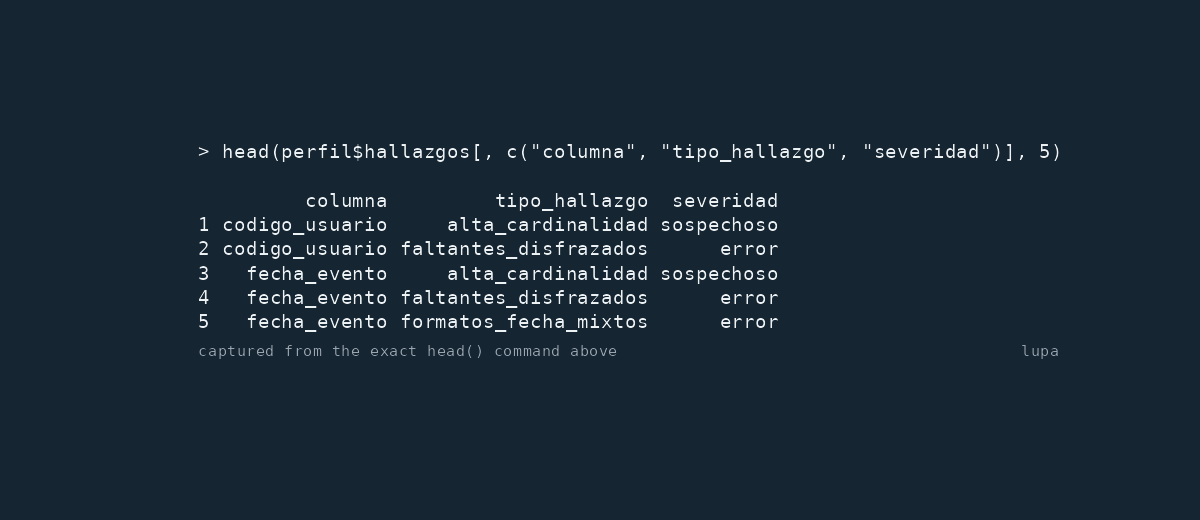
summary() describes columns one at a time. lupa compares representations, crosses columns and rows, and returns perfil$hallazgos: an inspectable table with a finding type, severity, evidence, counts, a suggestion and bounded row traceability. A zero finding means that a diagnostic ran and found nothing; a diagnostic that could not run is kept separately in perfil$cobertura_diagnosticos, rather than being silently reported as clean.
This is a real slice of the output from the included data:
data(datos_operativos)
perfil <- perfilar(datos_operativos, analizar_dependencias = FALSE)
perfil$hallazgos[, c("columna", "tipo_hallazgo", "severidad", "evidencia")]
Among the outputs of that run are:
| What it exposes | tipo_hallazgo |
Example in evidencia
|
|---|---|---|
| Missing values hidden behind codes | faltantes_disfrazados |
NULL (1) |
| Mixed date representations | formatos_fecha_mixtos |
%d/%m/%Y (4); %Y-%m-%d (4); ... |
| Trailing whitespace | espacios_sobrantes |
1 valores; ejemplos: "web " |
| Inconsistent capitalization | mayusculas_inconsistentes |
"web"; "Web" |
| Declared and inferred types disagree | tipo_declarado_distinto |
Declarado: texto; inferido: fecha |
| A constant column | constante |
Valor: principal; frecuencia: 13 |
| Exact duplicate rows | filas_duplicadas |
2 filas en grupos duplicados (1 excedentes) |
| Repeated columns | columnas_duplicadas |
id_registro = id_copia |
In a purpose-built table, the profile emitted 15 kinds of finding, including mixed currencies and units, mixed date formats, disguised missingness, extra spaces, inconsistent capitalization, spelling variants, numbers stored as text, near-keys, constants and structural absence. On a reference bank with known defects it recovered 9 of 9 planted defects; on 31 clean tables it produced 0 error-severity findings and 8 signals to review. The three figures are pinned by tests/testthat/test-ronda107.R, so they cannot age in silence.
The current canonical vocabulary has 58 tipo_hallazgo names. The names are Spanish because they are part of the public API:
alta_cardinalidad                    anio_de_dos_digitos
bloqueo_por_con_perdida              casi_clave
casi_duplicados_vocabulario          celdas_multivaluadas
ceros_no_permitidos                  clave_con_ausentes
clave_no_unica                       codificacion_invalida
codificacion_rota                    columnas_duplicadas
constante                            controles_invisibles
coordenada_fuera_dominio             crs_no_declarado
dato_personal_posible                desviacion_benford
duplicados_aproximados               duplicados_exactos_columnas
duplicados_exactos_normalizados      entidades_html
espacios_sobrantes                   faltantes
faltantes_disfrazados                fecha_fallecimiento_fuera_rango
fecha_nacimiento_fuera_rango         fecha_partida_columnas
filas_duplicadas                     formato_fecha_ambiguo
formatos_fecha_mixtos                geometria_invalida
geometria_vacia                      integer64_fuera_precision_double
mayusculas_inconsistentes            monedas_mixtas
negativos_no_permitidos              nombres_columnas_problematicos
normalizacion_unicode                numero_como_texto
outliers                             patron_raro
posible_ausencia_estructural         posible_centinela_numerico
posible_identificador                regla_silencia_ausencia
relacion_aritmetica_columnas         relacion_orden_columnas
separadores_en_campo                 tipo_compuesto_no_analizado
tipo_declarado_distinto              tipos_geometria_mixtos
unidades_mixtas                      valor_concentrado
valor_fuera_de_aplicabilidad         valores_no_finitos
variantes_equifrecuentes_vocabulario zona_horaria_fecha_hora
The valor_concentrado signal implements the measured M2 rule. It considers only numeric columns with at least 20 non-missing valid values and at least 10 distinct values. It emits a sospechoso finding when the modal frequency is at least five times the second-highest frequency and the modal value accounts for at least 0.15 of valid values. Its evidence reports the modal value, both frequencies, the ratio, and the fraction. A legitimate value can dominate, so this is never an error. Non-eligible columns do not receive a cobertura_diagnosticos row: categorical distributions are outside the signal’s intended scope.
The measured blind spots are part of this contract: concentrations below 15% are not detected, and natural ties in small integer columns can keep the ratio below five. The measurement found zero false positives in 114 clean eligible columns, with a 2.2x margin.
What it does not do
lupa does not turn the name of a quality framework into a measurement. A framework is a taxonomy; a factor is measured only when the data provide evidence or the user declares the requirement and metric that will measure it. The following is the measured coverage of the included frameworks:
| framework | factors | reachable by declaring requirements | out of scope | measured by perfilar() alone |
|---|---|---|---|---|
| AGESIC | 17 | 12 | 5 | 2 |
| CEPAL | 19 | 6 | 13 | 0 |
| ISO 25012 | 15 | 15 | 0 | 0 |
The 13 CEPAL principles outside scope are not an engine limitation: they speak about the statistical system and its institutional or production process, not about values in a table. ISO 25012 is fully coverable when its requirements and metrics are declared. cobertura_analisis() keeps these distinctions visible; an absent finding is not a claim that the data are good.
lupa also does not certify a dataset, invent a global score, or modify the input as a side effect of profiling. A score is available only when the user declares weights and a measurement model; cleanup returns a copy and keeps the original data intact.
Which databases does it run on?
Seven engine/version combinations were measured against real engines today. Each produced the 38 requested metrics, declared 7 as no_aplica, and detected the id key in the test table.
| engine | version | status |
|---|---|---|
| PostgreSQL | 16 | measured against the real engine |
| PostgreSQL | 9.3.25 | measured against the real engine |
| MariaDB | 11.8 | measured against the real engine |
| MySQL | 8.4 | measured against the real engine |
| SQLite | — | measured against the real engine |
| DuckDB | — | measured against the real engine |
| SQL Server | 2022 | measured against the real engine |
| Oracle | — | not measured in this matrix |
| BigQuery | — | not measured in this matrix |
requisitos_motor() contains 12 entries. Nine are named engine entries when the two Oracle version rows are counted separately; dbi, odbc and otro_dbi are generic compatibility entries, not additional measured engines.
How to start
Until the first CRAN release, install the development version from GitHub:
pak::pak("sebollin/lupa")Then these five lines take a first look at a table and its declared coverage:
library(lupa)
data(datos_operativos)
perfil <- perfilar(datos_operativos, analizar_dependencias = FALSE)
head(perfil$hallazgos[, c("columna", "tipo_hallazgo", "severidad")], 5)
cobertura_analisis(perfil)
perfilar() is read-only. The next step, when a finding is confirmed as a requirement, is the guided route described in flujo-guiado.
🔎 How lupa works in practice
lupa is an auditable R toolkit that connects first-pass profiling with a quality model declared for a particular use, explicit measurement, controlled cleanup of a copy, and approximate duplicate detection at scale. Instead of a single opaque score, every result carries its scope, evidence, and uncertainty.
Whole databases, not just one table. coleccion() declares which tables make up a database — schema included, because the schema is part of a table’s identity — and perfilar_coleccion() returns one row per table plus the coverage of what it could not measure. The boundary is declared, never discovered: walking a catalogue would turn a permissions error into a result, and real collections run past a thousand tables across dozens of schemas. Tables a credential cannot read land in cobertura_coleccion with their reason, never as a zero — partial permissions are the normal case, not the edge. There is no snapshot: every table carries the moment it was measured, and the object says so.
Contradictions no single column shows. Declare that several columns encode the same fact with senal_redundante(), and detectar_discordancias() reports the rows where they disagree — the year of the date against the fiscal year against the file year. Each of the three can be perfectly plausible on its own and still contradict the others. The group is declared, never guessed: two year columns might be birth year and enrolment year, and there is no reason for those to match.
Findings you can verify, not just read. Pass clave to perfilar() with the columns that identify a row, and every finding’s traceability carries those values for the rows it points at — so you can look the case up in the source system without opening the table. Row indices stay as the fallback; trazabilidad$localizador says which one you got. There is a tension the feature cannot ignore: the key that lets you verify is exactly what identifies a person, so a key column classified as personal data comes back masked, the same way evidence does, and claves_protegidas says which.
And it reaches the quality model too. Referential metrics report which candidate was closest and at what distance; when that reference table is a register of people, the value comes out as [valor protegido] and the distance is kept. A reference table carrying no personal data keeps its evidence intact.
And masking reaches every output, not just the mode —scoped by column: what describes the protected column is replaced, not every occurrence of that text. "S/D" can be a sentinel in the ID column and the “no data” marker in sexo, and publishing it in sexo reveals nothing about the ID; what has no column to attribute it to, such as a duplicate-rows finding, stays masked everywhere—. Each finding’s description, evidence and suggestion; the coverage motivo and como_resolverlo; the parameters of a plan action; the “Ejemplos reales” that guiar_limpieza() prints to the console; and the bounding box of a protected geometry, whose four bbox_* fields become NA with bbox_alcance = "no_publicado_por_geometria_protegida". In every case the signal is kept and the value hidden: the example still shows which rows match and in which columns, and the structural-absence finding is still raised without naming the threshold. Values are replaced longest first, so a protected value that is a prefix of another —Maria Nunez and Maria Nunez de Castro in the same column— does not leave the longer one’s tail published. A sweep over the finding types watches this, checking first that each one was actually raised.
The floor recognises three shapes of the same value: the exact one, the one that differs only in separators or in the case of its ASCII letters, and the one that shares a run of six or more digits with a protected value —an ID without its check digit—. It also splits the values an ejemplos cell publishes joined: without that, a document that only travelled inside a free-text column was published in full, because the needle was the joined string and that string exists nowhere else in the output. The run comparison is limited to digits on purpose: applied to text it would mask an ordinary word for sharing a stretch with a surname, and that silences report content instead of protecting a datum.
Profiling never touches your data. No analysis function alters the table it receives — not its values, its types, its names, or its attributes — including data.table inputs, which R allows to be modified by reference. Only the remediation layer produces different data, and it returns a copy: the table you passed in is still the table you have. A regression test asserts this for every entry point.
🌎 API language
The public names are Spanish in examples, help pages, and vignettes:
| Spanish API | English meaning |
|---|---|
perfilar() |
profile |
analizar() |
analyse |
marco_calidad() |
quality framework |
planificar_limpieza() |
plan a cleanup |
guiar_limpieza() |
guide a cleanup |
aplicar() |
apply a selected cleanup |
medir() / tablero_calidad() / evaluar()
|
measure / dashboard / evaluate |
detectar_duplicados_aproximados() |
find approximate duplicates |
reportar() |
create a report |
The Spanish README tells the same story. Contributors should keep the public contract in Spanish; the surrounding guidance can be internationalised.
⚡ A complete analysis and report
Until the first CRAN release, install the development version from GitHub:
# install.packages("pak")
pak::pak("sebollin/lupa")
Then profile a table or run the complete analysis route:
library(lupa)
data(datos_operativos)

perfil <- perfilar(datos_operativos, analizar_dependencias = FALSE)
head(perfil$hallazgos[, c("columna", "tipo_hallazgo", "severidad")], 5)

analisis <- analizar(datos_operativos)
analisis$tablero
archivo <- tempfile(fileext = ".html")
reportar(analisis, archivo = archivo)
stopifnot(file.exists(archivo))
unlink(archivo)
Profiling is read-only: it never changes the input table. Findings are ordinary inspectable data frames, and personal-data evidence is masked when the classification warrants it. This is a real console preview:
perfilar() console result🧭 What can I do with lupa?
The pkgdown reference and the linked vignettes are the detailed manual. This table is the short map:
📐 Scope: what uses every row and what is sampled
perfilar() uses every row for table and column counts, real and disguised missingness, distinct values, exact duplicates, quantitative summaries, and the findings derived from those quantities. «Every row» is the scope, not the content: a quantitative summary still leaves out what does not count as a number — NaN, Inf, text the conversion cannot read, and the sentinels declared in sentinelas_numericos — and when it does, it says so: n_valores_excluidos_resumen counts them, estado_resumen_cuantitativo stops saying "calculados", and cobertura_diagnosticos gets its row. The breakdown of the non-finite values stays in n_nan, n_infinito_positivo and n_infinito_negativo, and when no usable value survives the state says so instead of claiming it computed anything, and it tells two different cases apart: "sin_valores" when the column held no present value in the universe the summary measures —empty, all NA, or with declared applicability leaving that universe without values, in which case the ones outside are declared in n_presentes_fuera_de_aplicabilidad— and "sin_valores_utilizables" when it did hold values and none of them was usable, as in a column of thirty Inf —which publishes n_faltantes = 0 and n_distintos = 1— or one whose sentinels took every value. It says so for an integer64 column just as for a double one. The exclusion of non-finite values is declared in every class: a date column holding an Inf publishes n_valores_excluidos_resumen = 1 and does not count it among the summarised dates. Text lengths declare their own universe through n_longitudes_resumidas, because nchar() cannot measure a value whose bytes are not valid UTF-8 and that one stays out of the average. None of that depends on sampling being on. By default, muestra = 1e5 limits pattern discovery, type inference, date-format discovery, and the common sample used to search for functional dependencies. Set another limit or Inf to change or disable that sampling.
For inferred temporal types, estado_tipo_inferido distinguishes confirmado, candidato, and NA; a 100% compatible ambiguous date remains a candidate.
Personal-document validators have a separate preliminary filter: muestra_validadores = 1000 by default. A validator that passes that filter is then evaluated on the complete column; Inf makes even the preliminary pass complete. Approximate duplicates are off by default and have their own declared bounds when enabled.
In detectar_duplicados_aproximados(), pares$tipo_par is self-describing: exacto means the stored texts are equal, exacto_normalizado means they only match after the declared normalization, and aproximado means they remain similar rather than equal. pares$igualo_normalizar marks the middle case. The corresponding scope counts are n_pares_exactos, n_pares_exactos_normalizados, and n_pares_aproximados.
The casi_duplicados_vocabulario diagnostic runs per column. Even when two columns have the same vocabulary, each keeps its own coverage row and findings; the cost of comparing identical vocabularies may therefore repeat. This is deliberate, so frequencies and scope from different columns are never mixed.
The result records the effective scope in meta$muestra, meta$filas_analizadas, and meta$muestreo; each column also records n_filas_analizadas_tipo and muestreado_tipo_inferido, while the dependency table carries its analysed-row and sampling attributes. analizar() reuses muestra = 1e5 for its profile, distributions, and observed-level enumeration, and declares separate limits for associations and the other components.
🗄️ Engines: what is tested and what is expected
perfilar_dbi() does not promise a universal dialect. It resolves the dialect with a zero-row probe before issuing the aggregate block, and whatever the engine rejects is recorded as unavailable with its reason — never as zero.
| engine | dialect | status |
|---|---|---|
| SQLite | limit |
tested against the real engine: 38 metrics, 7 no_aplica, and key id detected |
engine that rejects LIMIT
|
top / portable
|
tested with a simulated engine in the suite |
| engine that folds aliases to upper case | any | tested with a simulated engine |
engine that rejects SELECT * over one column |
any | tested with a simulated engine |
| PostgreSQL 16 | limit |
tested against the real engine: 38 metrics, 7 no_aplica, and key id detected |
| PostgreSQL 9.3.25 | limit |
tested against the real engine: 38 metrics, 7 no_aplica, and key id detected |
| MySQL 8.4 | limit |
tested against the real engine: 38 metrics, 7 no_aplica, and key id detected |
| SQL Server 2022 | top |
tested against the real engine: 38 metrics, 7 no_aplica, and key id detected |
| DuckDB | limit |
tested against the real engine: 38 metrics, 7 no_aplica, and key id detected |
| MariaDB 11.8 | limit |
tested against the real engine: 38 metrics, 7 no_aplica, and key id detected |
| Oracle |
fetch_first / rownum
|
not measured in the current matrix |
| BigQuery | portable |
not measured in the current matrix |
| any other DBI-compatible engine | portable |
fallback: dbSendQuery() + dbFetch(n)
|
The claim is reproducible: benchmark/verificar_motor.R takes any DBI connection and checks five things — that the profile has five columns, the dialect is resolved by probe, the engine’s mean agrees with R over finite values of ordinary scale, the primary key is read from the catalogue, and coverage is returned as a table.
That qualifier is not an excuse: it is what was measured. With NaN or infinities, with values that make an accumulated sum lose precision — {1e16, 1, -1e16}, whose mean the engine gives as 0 and R as 0.3337 when the truth is 1/3 — or against an engine whose percentile is broken for large DECIMAL, the two paths do not agree. That is why perfilar_dbi() cross-checks its two blocks whenever both exist: if they differ beyond tolerance, a divergencia row lands in resumen_tabla$cobertura carrying both values and the sample’s coverage. It picks no winner — the package does not know which one is true — but it does not keep quiet about the disagreement.
What that script checks is behaviour, and it can be redone against any connection. The timings of those runs — the seconds and row reads that appear in the release notes — cannot be redone from the repository: they need the infrastructure of the run, up to two million rows by forty columns on an engine brought up for the occasion. They are published as what they are, references from a one-off run, and no result of the package depends on them.
Expected means the dialect is built and tested against a simulated engine that reproduces the restriction, not that it has been run against the real engine. The distinction matters, which is why it is written down: the defects this version fixed did not surface in eight green environments precisely because all of them used the same engine.
Every engine added to this table so far has found a defect no simulated engine could. DuckDB found the sharpest one: it accepts TABLESAMPLE SYSTEM (10) WHERE 1 = 0 and rejects the same clause without the filter, because with a trivially false filter its parser never validates the sampling method. The capability probe used exactly that filter to stay cheap, so it passed and the real query failed. A probe that does not exercise the form it later emits proves nothing — the same lesson the standard-deviation probe taught one round earlier.
The dialect can be declared with dialecto = if the probe gets it wrong. A partial failure never discards what was already measured: if reading the sample fails, the object comes back with a complete resumen_tabla, perfil_muestra = NULL, and a coverage row carrying the reason. If the sample was not requested, coverage uses no_solicitado, which is not a failure; request only aggregates with bloque_muestra = "solo_agregados". This option is independent of universo: with muestra_motor the SQL aggregates still use the engine’s sampled relation, but no sample rows are fetched or materialized in the client spool. The coverage row is no_solicitado and the materialization metadata records filas_vistas = 0.
And it declares what the engine cannot do. sentinelas_numericos, aplicabilidad and columnas_opcionales change what perfilar() summarises, but the SQL aggregates are computed without them: AVG() knows nothing about sentinels. When one of them is used, coverage gets a degradado row saying so and pointing at perfil_muestra — because a single call could publish two different means over the same rows, 1045.09 in the engine summary and 50.21 in the sample one, with nothing to warn you.
Knowing what is missing before you hit it
lupa has two hard dependencies, cli and data.table. data.table is used only to accelerate the exact count of duplicated rows, and it is never imported into the namespace; tables with list or matrix columns, or with NaN, fall back to base R, which is what fixes the result. Everything else is optional — and what used to happen when something was missing was an R error, or a driver error, that named neither what was missing nor how to get it. The hard case is not the R package but the system library underneath it: RMariaDB does not compile without the MySQL or MariaDB client headers, ROracle needs Oracle Instant Client, and someone staring at installation of package 'RMariaDB' had non-zero exit status has no way to know the answer is libmariadb-dev.
requisitos_motor()            # the whole catalogue
requisitos_motor("oracle")    # what Oracle needs, and how to get it
For each engine it declares the R package, the system library with its name on Debian and on Fedora, the way around it without administrator rights where one exists, the expected dialect, and whether it is tested against the real engine. The escape hatches are not hypothetical: SQL Server had no ODBC driver and no way to install one, and it was solved by compiling FreeTDS into a user prefix and pointing odbc at the .so by path; Oracle Instant Client unzips into a user directory. Neither needed sudo.
What it does not do is claim to have checked a system library it cannot check. When it can only say “the R package is missing, and if installing it fails to compile, this is what you need”, it says exactly that — the package’s own invariant applied to its own installation.
One query per batch, not one per column
Profiling issued one query per column for each block of metrics. On a table of tens of millions of rows that is the cost: not the sampling, the number of scans. The flat aggregates — COUNT(col), min/max/mean/zeros/negatives, and standard deviation — are now asked for several columns in one query, in batches. COUNT(DISTINCT ...) keeps a separate query class; the mode stays one per column, because it groups. The median keeps a per-column fallback, but where the engine probe accepts PERCENTILE_CONT(...) WITHIN GROUP several medians travel in a single SELECT per batch. On PostgreSQL 9.3 and SQLite, where that function is unavailable, the per-column median keeps LIMIT but makes the count a scalar subquery of the same statement. The probe also checks integer division (% and /); if a dialect does not accept that form, the result declares that it kept the two-query path.
With estrategia_distintos = "aproximada_motor", a distinct count is consolidated only when the capability provides an expression that can be embedded in the SELECT. If it only builds a complete query, valid counts and distinct counts are issued separately, and each record keeps the method of the query that was actually run.
Median strategy is independent. estrategia_mediana = "aproximada_motor" probes an exact native form first, then the exact per-column form, and only then an approximate native function. An exact median therefore remains calculado, with error_esperado = "no_aplica"; only an approximation that actually ran is estimado.
Consolidated medians are probed before use; on SQL Server they require compatibility level >= 110. The probe is not a promise of activation: known reasons for it not to activate are that the function is unavailable or that the engine rejects the probe. The engine message is kept in meta$mediana_consolidada$motivo, and the per-column median is retained.
Measured against PostgreSQL 16 with 2 million rows by 40 columns:
| configuration | before | after |
|---|---|---|
metricas = "validos" |
46 queries, 5.4 s | 8 queries, 2.4 s |
metricas = c("validos", "basicos", "desvio") |
128 queries, 15.2 s | 14 queries, 5.3 s; 10 queries with flat fusion |
Same 160 and 400 metrics computed, and the same numbers: on one table seeded once, the consolidated profile and the previous one agree on all sixteen summary fields across six column types.
If a batch fails, the batch is not lost. Its halves are probed by bisection: accepted groups are reused as measurements and culprit columns are retried per metric. Whatever still fails is left no_disponible with its reason while its neighbours are computed. If the probe budget runs out, pending columns remain unmeasured; they are not assumed to be culprits or readable. The degradation has its own tests.
resumen_tabla$sql keeps one row per column and metric with every field it had, and adds lote and columnas_compartidas so a shared query is visible. It also adds consulta_id, which identifies the statement that produced each measurement and defines the verifiable consistency group. The inherited query field is now named id_consulta, without an alias; it identifies the data query. muestra_id is reserved for the materialized relationship and is published in meta$materializacion, never as a second name for the query identifier.
For universo = "muestra_motor" with bloque_muestra = "con_muestra", the engine selection is materialized exactly once in an external client-session spool. Its trailer verifies muestra_id, snapshot_id, orden_id, n_filas, bytes and checksum on reread. Every profile pass reads that spool; it never re-samples the engine. With bloque_muestra = "solo_agregados", the SQL aggregates still use the sampled relation, but the row block is not selected, fetched or materialized. A chunk is checked against max_bytes_materializacion before writing, and an excess publishes spool_presupuesto_excedido plus muestra_inestable:presupuesto_materializacion, with no hybrid result. The spool does not write to the DBI connection or create temporary engine objects. meta$materializacion records backend, version, checksum, bytes and budget when a spool exists; the no-solicitud path records estado = "no_solicitado" and zero rows viewed. The measured crossover is part of the declared cost, not a speed promise: against PostgreSQL 16 with 2 million rows, a 500,000-row sample took about 5.6 s with the spool versus 3.3 s when every pass re-sorted independently; the spool is chosen for identity and bounded reuse. Across 10,000, 100,000 and 500,000 rows, spool totals were 0.448, 1.684 and 5.598 s, while independent re-sorts were 0.814, 2.178 and 3.265 s (crossover between 100,000 and 500,000).
The same SQL audit includes memoria_trabajo: creciente, acotado, or NA, to flag work that should not be recomputed incrementally over a larger table.
Every flat aggregate query that carries n_validos also carries COUNT(*) AS n_total_consulta in the same statement. Completeness uses that local denominator, including after bisection; it does not combine a total from another batch. The universe total is kept separately when profiling a sample or when no aggregate can carry it. The exact distinct query includes COUNT(column) AS n_validos_guard beside COUNT(DISTINCT column): the hard bound is applied only when both values have the same consulta_id. If an approximate capability cannot provide that guardian, the check is reported as unavailable and no inconsistency is attributed to the engine. Batch sizes are separate: tamano_lote_planos controls flat aggregates and tamano_lote_distintos controls cardinalities. The latter defaults to 2: the measured shared read was constant between batches on the reference PostgreSQL server, so two cardinalities share one pass. The measured two-cardinality batch kept nearly the same time per column as one and spilled less than wider batches. The moda query also tries to bring SUM(COUNT(*)) OVER () AS n_validos_guard beside its frequency. The form is probed before use; if the engine rejects it, the previous moda query is retained and the fallback is published in resumen_tabla$meta$moda_guardian. When accepted, the bound frecuencia_moda <= n_validos is checked inside that same statement.
Cost and spill are announced before they are paid
When perfilar_dbi() asks for COUNT(DISTINCT ...), the flat aggregates run first when they were requested, but they are not a time reference for distinct counts. With instrumentar = TRUE the package measures the first distinct batch in the same run and, if another batch remains, announces a projection after that batch and before the second. The figure is the median duration of the queries in the first distinct batch multiplied by the number of distinct batches; the message names that source and labels itself an estimate. With one batch there is nothing left to avoid, so no projection is published. A request with metricas = "distintos" therefore still receives the warning when there are multiple batches. This time projection does not use reltuples.
The same channel now announces the cost of the two expensive metrics that were missing: mode is projected from the sum of the columns’ cardinalities, and median from the row count. Each has its own switch and seconds threshold, enabled by default from 30 seconds: avisar_costo_moda/umbral_segundos_aviso_moda and avisar_costo_mediana/umbral_segundos_aviso_mediana. The warning is emitted before the projected query runs and remains in meta$costo_moda or meta$costo_mediana, separate from meta$costo_distintos because each projection follows a different cost dimension.
When possible, mode measures the first query in the current run and uses its milliseconds per distinct value for the remaining columns. If exact cardinality is unavailable, it uses whatever source exists (for example, the catalog) and says so; with no source, the projection is unavailable. Median knows the row count after the first count. The first measured median becomes the local reference for the remaining ones; if a single total median leaves no local measurement, it uses the declared bank reference of 68 ms per million rows, taken from another run. That reference is never presented as a measurement of the current run. If the initial query that obtained the row count was measured and gives a higher bound, that bound is also published as observed reading time —not as a median measurement—so a freshly loaded large table does not stay falsely quiet.
On PostgreSQL, preparation also reads pg_stats.n_distinct, pg_stats.avg_width, pg_class.reltuples and the session’s work_mem — plus hash_mem_multiplier from PostgreSQL 13 on — to estimate the size of the aggregation hash. If it exceeds the effective limit, the package warns before the first COUNT(DISTINCT) and says that raising work_mem for this session can avoid the spill. The diagnosis lands in meta$estimacion_derrame, always as an estimate and never as a measurement; the package changes no setting and waits for no confirmation.
Also on PostgreSQL, when pg_stat_statements allows attributing exactly one call from this run, the report adds the real spill and the number of temporary blocks written. When attribution is not possible the state is declared unavailable: elapsed time is never presented as evidence of a spill. Where the measurement exists, it prevails over the estimate — even if the estimate stayed below the limit, the report says a spill was measured.
SQL durations have a sum-safe unit
resumen_tabla$sql has one row per column and metric, but duracion_ms is the duration of the query and is repeated on every row produced by that query. The table now includes nivel, following resumen_tabla$tiempos: the first row of each consulta_id is nivel = 1 and the repeated rows are nivel = 2. Sum duracion_ms only for nivel = 1 (and use na.rm = TRUE when needed); summing the whole column counts shared queries more than once. Rows without a query keep NA in their duration and do not claim a measurement.
Reading a profile without knowing its shape
perfilar() returns a flat perfil; perfilar_dbi() returns a container. So perfil$general$filas worked on one and returned NULL on the other, where the count lives in resumen_tabla$meta$filas. A silent NULL in a measurement script is the worst way to fail: it does not warn, and everything after it computes on nothing.
They work over perfil, analisis, perfil_dbi and perfil_coleccion, and they do not invent what is not there: a DBI profile with no sample read returns an empty findings table with its warning, and sql_perfil() on an in-memory profile returns NULL, because a table with no rows would suggest SQL was issued and found nothing.
A budget measures work, it does not count units
A cap that counts units treats a column of ten-character codes and one of thousand-character WKT alike. A table in the PostGIS catalogue — 3,912 rows — took 243 seconds, and the vocabulary detector was 99.6% of it: 800 distinct values are 319,600 pairs, well under the two-million cap, but each comparison was a Jaro-Winkler over 900 characters.
The budget is now measured in character comparisons, the inner loop of the distance. Calibrated against measurement, the pathological column drops from 61.3 s to 4.6 s. An ordinary column of two thousand values is compared in full as long as its values are under about a hundred characters: the budget bites when L² · n(n−1)/2 exceeds 2e10, which for two thousand distinct values means a length of 101. Saying “two thousand values are compared in full” without that qualifier was wrong, and wrong in the worst place — the 900-character WKT column that motivated the budget is exactly the kind that gets trimmed. What does get trimmed is declared: how many normalised forms went uncompared, how much work that was, and which cap did the trimming.
A length cap protects the distance signal
Normalised edit distance is designed for names, addresses and identifiers, not documents. Five seeds were measured with random text pairs: one pair differed in one character and the other in 1,000. The table shows their median. The many-character pair stopped being distinct at the default 0.10 threshold before the one-character pair stopped looking close:
| length | distance, 1 character | distance, 1,000 characters |
|---|---|---|
| 10,000 | 0.000400 | 0.193195 |
| 20,000 | 0.000150 | 0.125923 |
| 25,000 | 0.000347 | 0.104511 |
| 50,000 | 0.000053 | 0.064559 |
The observed crossing is between 25,000 and 50,000 characters. The default 10,000 cap leaves a five-fold margin before that loss of discrimination. detectar_duplicados_aproximados() publishes it in alcance$max_largo_valor; when a column exceeds it, the complete combination is out of scope and alcance$columnas_excluidas_largo explains why. In perfilar(), the same decision appears in cobertura_diagnosticos with the reason, observed length and threshold. max_largo_valor = Inf or max_largo_valor_vocabulario = Inf explicitly restores the previous behaviour.
The cap is measured on the string that is actually compared: columns already combined and already normalised. Both halves of that sentence are load-bearing. Two columns of nine thousand characters each are below the cap on their own and reach eighteen thousand once joined; and the amplio normalisation expands ligatures, so a value can sit below the stored cap and above the compared one. alcance$largo_maximo reports that compared length, and is NA — not zero — when the cap does not apply and no length was measured.
The two caps are separate knobs on purpose. max_largo_valor_vocabulario governs the vocabulary rule inside perfilar(); the row-pair detector keeps its own, set through duplicados_aproximados = list(max_largo_valor = ...).
Wide-table cost is announced first
perfilar() projects the cell count before expensive work starts. The default warning starts at 100,000 cells, uses a reference of 10,000 cells per second and says that it is an estimate together with its source. The reference follows these measurements (run of 2026-08-30, reproducible with benchmark/medir_referencias.R): 500 rows by 50, 300 and 1,000 columns took 3.34, 13.63 and 43.85 seconds — about 11,000 cells per second, which is why the reference uses 10,000. There is no warning below the threshold or in non-interactive scripts. The projection is stored in meta$costo_tabla_ancha. avisar_costo_tabla_ancha = FALSE disables it per call and umbral_celdas_aviso_tabla_ancha = Inf silences it explicitly.
And when a budget must trim, the forms it keeps are the alphabetically first, not the first to appear. That distinction was a defect, measured on a real column — 45,400 street names from the national open-data catalogue, 8,318 distinct forms. The same rows yielded 26 near-duplicate groups in the order the file arrives, 70–85 shuffled, and 148 sorted. A profiler whose verdict depends on the row order is measuring the physical shape of the table rather than the data. Sorting first, all five orders yield 148 — and sorting also keeps near-duplicates adjacent, so the cut falls between families instead of splitting them.
The other trim, the one over pairs, follows the same rule, from the same kind of measurement. max_resultados keeps the closest pairs by ordering on distance, and among tied pairs it used to break ties by row position. Measured over 60 groups whose internal pairs share exactly the same distance, with the cut at 30, five different orders each returned 30 groups sharing none of them. It now breaks ties by the canonical order of the values, with a symmetric key so the result does not depend on which row came first within a pair either, and all five orders return exactly the same groups.
What no ordering fixes is that a cut inside a tie leaves out pairs that are equally close. That is not fixed: it is declared. alcance carries distancia_corte, n_en_distancia_corte and corte_en_empate, and that last one is not truncado under another name — it is FALSE when the cut lands on a unique distance.
Sample-size caps protect remote reads
perfilar() and perfilar_dbi() use the same sample-cap defaults: max_celdas_muestra = 1,000,000 cells and max_bytes_muestra = 512 MiB. In DBI profiles these caps apply only to perfil_muestra; the SQL aggregates still run over their declared scope. The cell cap is resolved from the row count and schema width before reading. The byte cap first reads a probe of up to 100 rows, then puts the resulting limit in the final SQL or dbFetch(n) call, so the full sample is not fetched and trimmed later in R.
When muestra = n and a cap is stricter, the smaller limit wins. The profile coverage declares the observed cells or bytes, threshold and reason, including which cap won. Passing Inf for both caps produces no crop declaration. plan_perfilado_dbi() exposes the same limits and says in advance when the cell cap will reduce the sample or when a byte probe will be needed.
Cost is planned before it is paid
Profiling a 158-column table with the default universo = "tabla_completa" emits 335 queries, and 327 of them scan, sort or group the whole table. The count follows the composition, not the column count: the same 158 columns as text only cost 252, because a median asks for a full sort per numeric column. muestra does not bound any of it — it bounds what is brought into R, not the work the engine does. So the cost is declared and chosen (benchmark/medir_plan_ancho.R reproduces the four numbers):
plan_perfilado_dbi(
  con, "tabla", universo = "muestra_motor", muestra_motor = 5000
)   # prepares and publishes a range
The plan gives a range for how many queries the profiling will emit, and it says so in attr(plan, "supuesto"). It does not scan data to decide cost: it reads the schema, probes capabilities and, with politica_costo = "por_cardinalidad", may read a structural guarantee or a catalogue source. It never launches COUNT(DISTINCT ...) just to resolve uncertainty. Consequently, the plan does not publish a temporal projection for COUNT(DISTINCT): the honest reference is the first distinct batch measured during execution, and the plan emits no data queries.
The low end is total: when cardinality is unknown, it assumes the policy will omit moda. The high end is total_maximo —also exposed as total_lotes_rechazados after adding bisection— and leaves open the path that executes them. If the engine rejects batches, up to 2n - 1 probes are added per batch of n columns. The real cost falls between the two when the sample can be built: if universo = "muestra_motor" and the engine does not accept the resolved form, the plan declares it in attr(plan, "muestreo") and drops the metrics that depended on it from the range. The run, in turn, publishes each of them as no_disponible with its reason: nothing that was not measured is reported as measured.
Distinct-count provenance is selected explicitly with estrategia_distintos. "exacta" is the default and emits COUNT(DISTINCT); "aproximada_motor" uses a native function only when the engine accepts its probe; "catalogo" reads PostgreSQL’s pg_stats.n_distinct and publishes it as an estimate, with guards for inheritance and sampled modes; on other engines it is no_disponible with its reason; and "omitida" emits no distinct-count query. An unavailable approximation does not silently become exact. The result separates the requested strategy, the resolved strategy, and its state in meta$estrategia_distintos and in the SQL rows.
The primary-key catalogue is queried on every run, even when the cost policy does not need cardinality. The response is published in resumen_tabla$meta$clave, with columnas, fuente, motivo, garantia, and estado. This is a metadata query and does not scan the table. A visible key without enough evidence keeps garantia = "desconocida"; a table without a declared key keeps "no_declarada", and a failed query keeps its reason instead of turning it into an absence of a key.
Structural sources used by the cost policy are resolved whenever the policy needs cardinality, even if the requested strategy is omitted or unavailable. The strategy’s availability controls whether cardinality may be measured; it does not hide a guaranteed key. If no structural source exists and measuring is not allowed, cardinality remains unknown and the policy follows its explicit unknown-cardinality rule.
estrategia_distintos and fuente_cardinalidad_costo are independent: the former controls how n_distintos is obtained or omitted, while the latter says where the ratio used by the cost policy comes from. A cost-policy decision cannot turn a requested approximate or catalogue strategy into COUNT(DISTINCT ...).
Each flat batch that computes valid counts carries its own COUNT(*) AS n_total_consulta, with no additional query; the plan publishes that composition. When a separate universe total is needed — for example, for a sample or when there are no flat aggregates — it remains an explicit query.
The part that is a hard design constraint is that the prediction does not depend on the engine: every capability probe costs a fixed number of queries even when it succeeds on the first form, because a cost that varied by engine would leave the user guessing again.
The decision to pay moda and median is explicit. politica_costo = "todas" is the default and preserves all requested metrics. With politica_costo = "por_cardinalidad", structural sources are resolved first. Valid and distinct values are measured only when no exact structural source is available and the selected strategy permits measurement; then only moda is omitted per column when n_distintos / n_validos >= umbral_cardinalidad. The default threshold is 0.5, it can be changed in the call, and it governs moda only. Median is not omitted by cardinality: the measured sweep is flat against the number of distinct values and is governed by row count. Every omission is declared in resumen_tabla$sql as omitido_por_costo, with the reason and how to ask for it anyway. meta$decisiones_costo records the reason for keeping or omitting each metric separately. An omitted, catalogue or unavailable approximate strategy never falls back to COUNT(DISTINCT ...).
The table summary declares meta$snapshot = FALSE, because its aggregates are separate statements and the table may change between them. When exact n_validos and n_distintos from different consulta_id groups are incoherent, cobertura adds alcance_distinto with both statements in the reason: it is evidence that the table changed during the run, not an error attributed to the engine or the package.
But counting queries does not answer the question the reader actually brings: fourteen queries over two million rows are far more work than two hundred over a thousand. So the plan also estimates magnitude, in real counts rather than an invented index — and it estimates it in two halves, because the clock is not always set by the engine. The engine half is filas_leidas and ordenaciones_completas, summarised in magnitud_motor; the client half is columnas_texto and pares_texto — how many pairs of forms the vocabulary detector could compare in R over the sample — summarised in magnitud_texto. magnitud is the larger of the two.
On PostgreSQL, when preparation has already read the catalog hierarchy, a positive pg_class.reltuples also supplies the row magnitude. The plan prints it as an estimate of catalog, not a measurement, and exposes the source in filas_fuente/estimacion_filas; the work projections for mode and median are published in proyecciones with the same label. A zero or negative reltuples (the usual pre-ANALYZE state) leaves rows and those projections unknown. Other engines keep the current unknown state.
Counting only the engine gave false verdicts out of true numbers: a 3,912-row PostGIS catalogue table with one geometry column stored as text asked for 64,592 row reads and no sorts — magnitude "baja" — and took 35 seconds with the work budget already calibrated, because what remained was in comparing forms, which is not a row read. It is the same table that took 243 seconds above, before the budget measured work instead of counting units. Printing the plan shows both halves, and the high-work warning names the levers that bound it, which differ on each side. It is an estimate and says so: the engine half counts the rows that would have to be read if no index helped, and the client half counts pairs, whose unit cost depends on value length — something the plan cannot know without reading them, so for very long text the real time is several times what the reference suggests. The published numbers do not depend on those assumptions, so anyone who disagrees with them can redo the arithmetic.
Processing memory is not estimated
plan_perfilado_dbi() explicitly says that processing memory is not estimated: it does not scale predictably with rows or cells, as measured. The plan still publishes the known work magnitude—rows, cells and text pairs—clearly labeled as magnitude, not memory consumption.
Measured reference data, not a prediction for the table in the plan — a single dated run (2026-08-28) against a remote production engine that this repository cannot re-run — put bringing the table at about 0.13 GB per million rows and processing in R at about 1.0–1.5 MB per thousand rows. The second figure varied by 1.62x between tables of the same magnitude; that variation is precisely why it is not used as an estimate.
Seeing all rows and having all rows in memory are not the same. In reference runs, 4.5 million rows fit in 0.6 GB and took 25 seconds to bring, while processing 4.5 million took about 7 GB and 12.8 million about 19 GB. The observed problem is processing in R, not the network or the database engine.
| dimension | what it does |
|---|---|
| defaults | every metric over the whole table |
metricas = c("validos", "basicos", "desvio") |
the historical seguro preset |
metricas = "validos" |
the historical conteos preset |
universo = "muestra_motor" |
one engine selection materialized in a client spool; TABLESAMPLE or a pseudo-random limited source is read once and reused |
estrategia_mediana = "aproximada_motor" |
exact native first, approximate only at the end; only an executed approximation is estimado
|
Every sampled or approximated metric travels saying so. estado distinguishes calculado, estimado and no_disponible, and each row carries universo, tamano_muestra, fraccion, metodo and error_esperado. For sampled SQL metrics, error_esperado is no_estimado when an error could be calculated under a probabilistic sampling plan but was not, no_estimable for the mode, median and observed cardinality, which have no simple bound without additional assumptions or a declared estimator, and no_aplica when no sampling took place. The motivo column gives the reason; metodo, tamano_muestra and fraccion retain the conditions of the run. No numeric bound is published without a justified formula.
In resumen_tabla$meta$muestreo, tamano_muestra is retained for compatibility and records the effective size requested from the query, filas_solicitadas records the original request, and filas_obtenidas records the rows returned by the perfil_muestra read. The latter is NA when that block was not requested or failed before reading. Distinct counts get their own state, observado_muestra: the cardinality of a sample does not estimate the cardinality of the universe without a declared estimator, so it is reported as what it is — what was seen in the sample, with the universe stated beside it. An engine with no sampling capability does not break: the engine sample degrades and says so in the coverage table.
If the sample query returns zero rows, there is no basis for measuring sample-scope metrics. They are published as NA with state no_disponible and a reason naming the empty sample; n remains the count from the full table. This does not imply that the column is empty, so lupa does not publish zero or start the sin_valores cascade.
An approximation is not marked as estimated when its query was not issued or did not return a usable value. Distinct-count provenance is selected separately with estrategia_distintos; if "aproximada_motor" is requested and the engine lacks the function, the metric is no_disponible and COUNT(DISTINCT ...) is not executed.
🕳️ Emptiness by design is declared, not counted as a defect
Every profiler assumes a table shape. lupa assumes one row is one fact, one column is one semantic domain, and an empty cell should have had a value. The third assumption is the one that hurts: an administrative table is full of legitimate emptiness — an open-ended validity interval, a survey skip pattern, columns that are mutually exclusive by subtype, an entity-attribute-value model. Counting those as missing is arithmetically right and semantically wrong.
aplicabilidad declares, per column, the rows where the column applies. Rows outside that universe leave n_faltantes and prop_faltantes instead of being reported as absence:
columnas_opcionales covers the simpler case, where absence is never a defect and there is no rule to write. The declared rule, the resulting universe, and the rows where the rule could not be evaluated all land in cobertura_diagnosticos: a narrowed universe without a record would be the same defect in reverse. Rows whose rule cannot be determined are counted apart, in n_aplicabilidad_indeterminada, because not knowing is not the same as not applying.
Declaring the universe also enables the symmetric error, which had no way to appear before: valor_fuera_de_aplicabilidad reports a value present where the rule says the column does not apply.
The same idea governs the statistical tests. Benford assumes a multiplicative process and Tukey’s fences assume a distribution; a numbering — an identifier, a code — is neither, and a code sitting far from the median says nothing about its quality.
Recognising a numbering uses density: an identifier occupies a compact stretch of the integers while a magnitude spreads across several orders. Uniqueness does not work, since an amount is nearly unique too. The public secuencia_entera_densa field answers only that coverage question; the separate moda_sobresale_secuencia_entera signal must not switch off the form shields that use the numbering. The sentinel guard reopens when a candidate is outside the range of the remaining numbering, or when that candidate is the standout frequency. The range signal is deliberately independent of frequency: -9 in a numbering from 1 to 1,505 is suspicious even when five legitimate values tie with it, while 999 appearing once inside 1..1,000 is not.
The criterion was chosen by measuring. A bench of thirteen columns with the known answer — five numberings and eight magnitudes with a bad value inside — compared four variants: crossing both signals gets all thirteen right and never silences a real bad value; density alone got eleven and silenced two. It lives in test-ronda118.R.
For an integer64 column, bit64 is loaded lazily when it is installed so its methods are registered before measuring. If it is not installed, the five sequence measures are NA and cobertura_diagnosticos records that secuencia_entera could not be evaluated. Numeric values that become published text use fixed notation at full precision, independent of scipen and digits, while preserving OutDec.
The same fixed representation drives personal-data classification, so scipen and digits cannot change that decision or erase declared numeric sentinels from meta. Drift and history keys compare names and configurations by bytes, including across a saveRDS() boundary and a changed locale.
Structural-absence suggestions mark names only in the copy used to compose text. They preserve the table’s names exactly as received and publish copy-and-paste code identically under LC_CTYPE = "C", including names with accents.
And what is not run is not switched off silently: it leaves its row in cobertura_diagnosticos with the measured reason — what share of the integers the column covers, how many values would have been flagged, how many rows out of how many the sample carries.
The same idea, reversed, yields a diagnostic no single signal could give. A 9999 may be an impossible age or a perfectly valid postal code, so the sentinelas_numericos list does not include it by default — and rightly so: flagging it always would break any column where that number is data. But a value that falls outside the fences, repeats, and has the shape of a repeated digit is a sentinel with all three together, and posible_centinela_numerico reports it without counting it as missing — that call belongs to whoever knows the column, by adding it to the list. A postal code 9999 repeated thirty times is not extreme within its column; a real amount of 9999 does not repeat; a year 1999 does not have that shape.
And adding it to the list has a consequence, which is the other half of the same idea: the package excludes what the user declares and includes what it merely suspects. A value declared in sentinelas_numericos leaves media, mediana, minimo, maximo and desvio — with n_valores_excluidos_resumen reporting how many it left out — just as NAs do, and just as the rows that aplicabilidad places outside the universe do. The default list, by contrast, reports without touching the numbers: it is a guess, and a guess does not move an average. moda and n_distintos keep describing what is stored, as they already did with an Inf.
The sentinel policy is compared as a numeric set. Reordering the values, supplying integers instead of doubles, or repeating a value therefore has the same meaning through both perfilar() and perfilar_dbi().
Uniqueness is not guessed: it is asked — and in a database, read. When the data arrives over DBI the primary key is declared in the engine’s catalogue, so nothing is suggested: it is read, in a single query chosen by the driver. And «this table declares no key» is kept apart from «the key could not be read», which are not the same thing.
For an unqualified name, the key published is the one of the relation the engine resolves, not that of a same-named table in another schema: the schema is asked of the engine, under its own rules. On top of that, a key whose columns are not among those just measured is discarded whole, on any engine, stating why. A key that does not belong to the measured table is worse than none.
Uniqueness is not guessed: it is asked. Declare the key with perfilar(clave = ...) and a key that repeats among the rows whose key is complete is a finding of severity error carrying the offending rows. When no row has a complete key the state is sin_casos_evaluables, not verificada: true over an empty set is true and misleading at once. The warning and meta$clave keep that check apart from missing values: a key may have no non-missing collision and still violate NOT NULL. The findings separate both facts: clave_con_ausentes enumerates rows that prevent that guarantee, while clave_no_unica reports repeated values only among rows with a complete key. A collision between missing values belongs to the first category and does not refute meta$clave$unicidad; if traceability groups those missing values with R semantics, the difference remains explicit. So that the user is not left facing a blank field, sugerir_clave() ranks the candidate columns by three signals it publishes separately — whether it identifies every row, whether it has no missing values, and how closely its name resembles a key’s — and elegir_clave() offers them numbered with an option to type another. Ranking is not deciding: a unique column may be a key or a magnitude that happens not to repeat, and that difference is not in the data.
DBI key lookup also keeps catalogue source apart from guarantee. Oracle is reported as guaranteed only when STATUS is ENABLED and VALIDATED; PostgreSQL and MySQL publish comparable catalogue states. MariaDB, SQL Server, SQLite, and DuckDB do not let this path distinguish that state, so a visible key there keeps an unknown guarantee.
Where no signal discriminates, lupa speaks. High cardinality in a text column is always reported, because the length of the values does not tell a catalogue from prose — it fails in both directions, measured — and the finding does not claim it is a defect: it offers the three possible readings so that whoever knows the column decides.
perfilar_por() answers the long format, where one column stacks unrelated domains. It profiles each group separately, drops the wholly-absent columns inside each group before profiling, and declares what it dropped.
lupa does not infer the model. But declaring the universe requires knowing the option exists, and someone profiling a conditioned table without declaring anything got exactly the misleading report the feature was built to prevent. So the package measures the evidence and offers it: when the value of one column decides which rows have another, or when two columns split the rows without overlapping, posible_ausencia_estructural reports it with severity ok, the measured evidence, and the line to paste:
valor_a  posible_ausencia_estructural  ok
  evidence  `tipo` predicts the presence of `valor_a` in 100.0 % of 200 rows,
            with 2 distinct values. The column applies when tipo is "A".
  suggests  perfilar(datos, aplicabilidad = list(valor_a = ~ tipo == "A"))
It suggests; it does not decide, and it never rewrites the universe on its own. Columns already declared are left out of the examination. On twenty real datasets shipped with R and sixty random tables with independent missingness it produces zero signals (rerun of 2026-08-30, reproducible with benchmark/banco_ausencia_estructural.R); it fires on the entity-attribute-value model, the survey skip pattern and the mutually exclusive columns, and stays quiet when ten per cent of the rows break the rule, because then the relation exists and is not a rule.
The other side of the same coin is regla_silencia_ausencia, also ok: a column declared optional or with its own universe that stays almost empty inside that universe gets a notice. The declaration worked and that is why the profile came out clean — the notice exists so that is a decision and not a side effect.
columnas_personales closes the equivalent gap on the other declaration the package cannot make alone. No lexicon of column names can be complete: a column holding identity documents can be called cod_benef, and no list of frequent names will recognise it. Declaring it wins over inference and is not re-examined.
The vignette vacio-por-diseno documents the assumption and the six table shapes where it does not hold.
🔢 Declared units and row traceability
Every finding declares the unit used by n_evaluados, n_afectados, and unidad_conteo. mayusculas_inconsistentes and normalizacion_unicode use valor_distinto: they count distinct values, while their trace remains a row trace. It lists every row containing an affected value, not only rows that are themselves defective. casi_duplicados_vocabulario follows the same contract: its count is the number of variant values, and its trace lists every row whose value belongs to a selected group, including the dominant form. A trace can therefore contain more rows than n_afectados; those rows are useful when a whole collision group must be reviewed or unified. The vocabulary detector is heuristic, so the trace is evidence for review, not a verdict that every row must be corrected. The trace presents non-dominant forms first and dominant forms afterward; its evidence reports how many displayed rows belong to each.
For patron_raro, resumen_patrones and the evidence show at most six rare patterns. Traceability uses the complete set of rare pattern names, without retaining their frequency table, up to a separate limit of 5,000 names. If that limit is reached, the trace scope is partial and cobertura_diagnosticos states the limit; the six-pattern presentation cap is not itself a trace gap. Every finding also reports the dominant pattern proportion and how many rows belong to non-dominant patterns excluded for exceeding umbral_patron_raro. If no dominant pattern reaches umbral_patron_dominante, no finding is emitted: the non-measurement, its observed proportion, and how to adjust that argument are recorded in cobertura_diagnosticos.
filas_duplicadas counts all rows participating in duplicate groups, matching the metric and the default action that marks those rows. The number of excess duplicates remains in the evidence. 0 means the check measured no affected units; NA means the count was not measured. The same distinction applies to diagnostic coverage: a check that could not run is listed in cobertura_diagnosticos, never silently converted to zero.
Traceability uses the same comparison in both directions as the count, including when an integer64 column does not honor duplicated()’s fromLast argument. Therefore n_afectados and trazabilidad$total always describe the same rows.
When a finding and its trace disagree, perfilar() preserves the finding and emits a warning with class lupa_trazabilidad_incoherente. The guard compares the pre-truncation total, checks both directions, and respects the declared counting unit; it is a diagnostic net, not a substitute for aligning the detector and its trace.
🛣️ perfilar() or analizar()?
Use perfilar() when you want the focused, inspectable profile: column summaries, patterns, inferred types, findings, diagnostic coverage, and undeclared structural relationships. Use analizar() when you want the full route around that profile: distributions, associations, temporal analysis, confirmable variable classification, a model proposal, a cleanup plan, conceptual coverage, and a dashboard.
With no confirmed model or proposal, analizar() measures every proposal row whose state is "lista" by default. That proposal was inferred by lupa; nobody has confirmed it. Use medir_propuesta = FALSE to keep the route descriptive, or supply a confirmed proposal/model. The function aggregates immediately and keeps the small dashboard; conservar_detalle_medicion = TRUE retains the row-level measurement detail.
Where the value distribution and the correlations live. Both are in analizar(), not in perfilar(), and that separation is deliberate: perfilar() is the cheap pass whose object you carry around, while distribucion_valores() and detectar_asociaciones() cost more and produce tables of their own. distribucion_valores() returns per-column frequencies and quantiles with a declared cap and truncation flag; detectar_asociaciones() returns Pearson between numeric columns — or Spearman, with metodo_numerico = "spearman", for a monotone relationship that isn’t linear — plus Cramér’s V and eta squared, each row declaring its method and its assumption. Both are exported, so you can call them on their own without paying for the whole route.
What it costs on millions of rows. perfilar() and analizar() work in memory, and on tables of millions of rows they are not a quick pass. These are measured reference data, not a prediction —a single, dated evaluation (2026-09-29) on production databases this repository cannot reproduce—: on three tables of between 3.7 and 4.3 million rows and 7 to 19 columns, perfilar() took between 14 and 59 minutes, and the same call repeated on the same table took 53 and 29; analizar() finished in 20 minutes on the 7-column table and in 97 on a 13-column one. The cost depends on the columns and their content as much as on the rows, and it varies between runs, so the figure does not extrapolate. At that scale, profile a sample of the table and call the pieces of analizar() you need on their own. [perfilar_dbi()] computes the aggregates inside the engine and brings back only a sample, but in that evaluation it was never measured on those tables. The sample perfilar() takes by itself is systematic and has no randomness, so the same profile is reproduced on the same data.
🚦 Severities and automation
severidad is an ordered factor: ok < sospechoso < error.
-
okrecords an observed condition that is acceptable or informational; it is not an adverse decision. -
sospechosois evidence worth reviewing. It is heuristic or needs domain context and must not by itself reject, repair, or suppress data automatically. -
errorstates that the applicable check crossed its declared criterion. Of these three levels, it is the only candidate for an adverse automated gate, and only after the project accepts that criterion and verifies the scope.
cobertura_diagnosticos is outside this scale. It lists checks that could not be evaluated and how to resolve them. Automation must inspect it as well as error: zero errors does not mean a clean profile when diagnostics were not run. Cleanup is always explicit—aplicar() changes only actions selected from an editable plan.
That plan states the unit it counts in: n_afectadas travels with its unidad_conteo, because a case-folding action announces three — the distinct values that collide — and changes ninety rows, and whoever decides needs to know which of the two they are reading. And aplicar() does not claim work it did not do: an action whose effect turns out to be nil is recorded as fallida with its reason, not ejecutada, even when an edited plan has no valid n_afectadas estimate. The observed effect is the control; the estimate is evidence, not a switch that can turn it off.
✨ What lupa does in detail
- Profiles a delivery and surfaces missingness, types, patterns, dates, and personal-data evidence.
- Profiles
sfgeometries and declares CRS, geometry families, emptiness, planar validity, coordinate domain, and bounding-box scope; it does not perform spatial analysis. Over PostGIS it reads the SRID of each EWKB, so a column with mixed SRIDs is declared as such and its domain is evaluated by group: ansf::sfccolumn can only carry one CRS. - Applies Benford’s law only when its preconditions hold, and records non-applicability in
cobertura_diagnosticos. - Reports
unidades_mixtasandmonedas_mixtasin a column without converting values or assuming exchange rates. - Reports
celdas_multivaluadasonly when homogeneous parts match the column’s patterns. - Finds
relacion_aritmetica_columnasas observed identities or proportions between numeric columns, not as domain rules. - Finds
relacion_orden_columnasbetween comparable columns and declares the comparison scope. - Finds keys, relationships, dependencies, and measurement granularities that were never declared.
- Reports
casi_clavewhen a non-temporal column has at least 100 rows, is almost unique, and its collisions concentrate in a few values, which separates a key with duplicates from free text of high cardinality. - Lets a project define its own quality framework instead of forcing a global score.
- Measures and evaluates explicit metrics, scales, validity rules, and referential domains. A contract that is missing a field abstains and says which field in
cobertura_metricas, instead of aborting the measurement of every other metric; a metric whose method fails on the data —a column without two values forErrorEstandar, an attribute the table does not have— becomesno_medible, with the method’s message and a warning, and the others are still measured; and any metric comparing a column against a declared temporal value warns when the two ends are not of the same class, because aDateis anchored to UTC midnight while aPOSIXctstands for its instant, and mixing them changes the number invisibly. - Produces editable cleanup plans, applies only selected actions to a copy, and keeps an audit log.
- Finds approximate duplicates with exact tiles, deterministic MinHash/LSH, blocking, cost estimates, and disk-backed lots.
- Repairs encoding damage in R, including repeated mojibake and CESU-8, while refusing unsafe lossy conversions.
- Follows quality through time and creates self-contained HTML reports.
🧪 Evidence, with its declared scope
Each check below uses a different declared unit and reference. None of them estimates a single package-wide accuracy.
| Check | Declared unit | Result | Reproduced by |
|---|---|---|---|
| Raha dirty/clean pairs | columns containing at least one changed cell | 26/26 received at least one finding; 8 further columns were flagged | benchmark/medir_lupa.R |
| Constructed clean controls | 31 tables | 0 error-severity findings; 8 review signals | test-ronda107.R |
| Real sanctions register | error-severity findings over 2,556 rows | 9/9 independently confirmed | benchmark/medir_sanciones.R |
Every row names what reproduces it, and that is part of the check. This table once carried three numbers nobody could verify from the repository: one described a control set that had shrunk from 43 tables to 31 — and its noise from 25 signals to 8, meaning the package had improved while the text still said the old figures — another counted nine seeded defects whose fixture is not here, and the third a real registry with no script to fetch it. The first was measured again, the second was removed until its fixture exists, and the third now has its script.
In the Raha pairs the dirty/clean comparison labels changed cells; it does not label every property observable in an unchanged column. Manual review found a supported observation in each of the eight further columns—constants, duplicated columns, inconsistent case, empty strings, and high-cardinality text. We therefore report neither precision nor diagnostic recall from Raha: 26/26 is column coverage, not evidence that every changed cell was identified. benchmark/ reproduces the table from the published sources and records the exact file fingerprints used by the published run, but only when lupa is installed from a build of these same sources. From the repository root, reproduce that condition and run the scripts with:
R CMD build . && R CMD INSTALL lupa_0.1.0.tar.gz
Rscript benchmark/verdad_raha.R
Rscript benchmark/medir_lupa.R
The benchmark records the installed version and full Built stamp and stops when that installation lacks a capability required by the published table.
Performance: four figures that come out of a CSV
A published timing ages with every commit, and a number nobody can rebuild turns into a lie without anyone noticing. So the figures below are not pasted from a console: benchmark/medir_figuras.R measures the lupa installation visible in .libPaths() —it prints its Built stamp, stops if it is missing, and also stops if that installation predates the last commit to the code, since then it cannot contain what the CSV would sign— and leaves the raw data in benchmark/datos/, one CSV per table with the commit as its last column; benchmark/graficar_figuras.R draws only what those CSVs hold, with base R and no graphics dependencies. Every figure carries the commit, the date and the machine in its footer. The counts —candidates, pairs, recall, loss— are deterministic and reproduce on any machine; times and memory belong to this machine and serve as an order of magnitude, not as a promise.
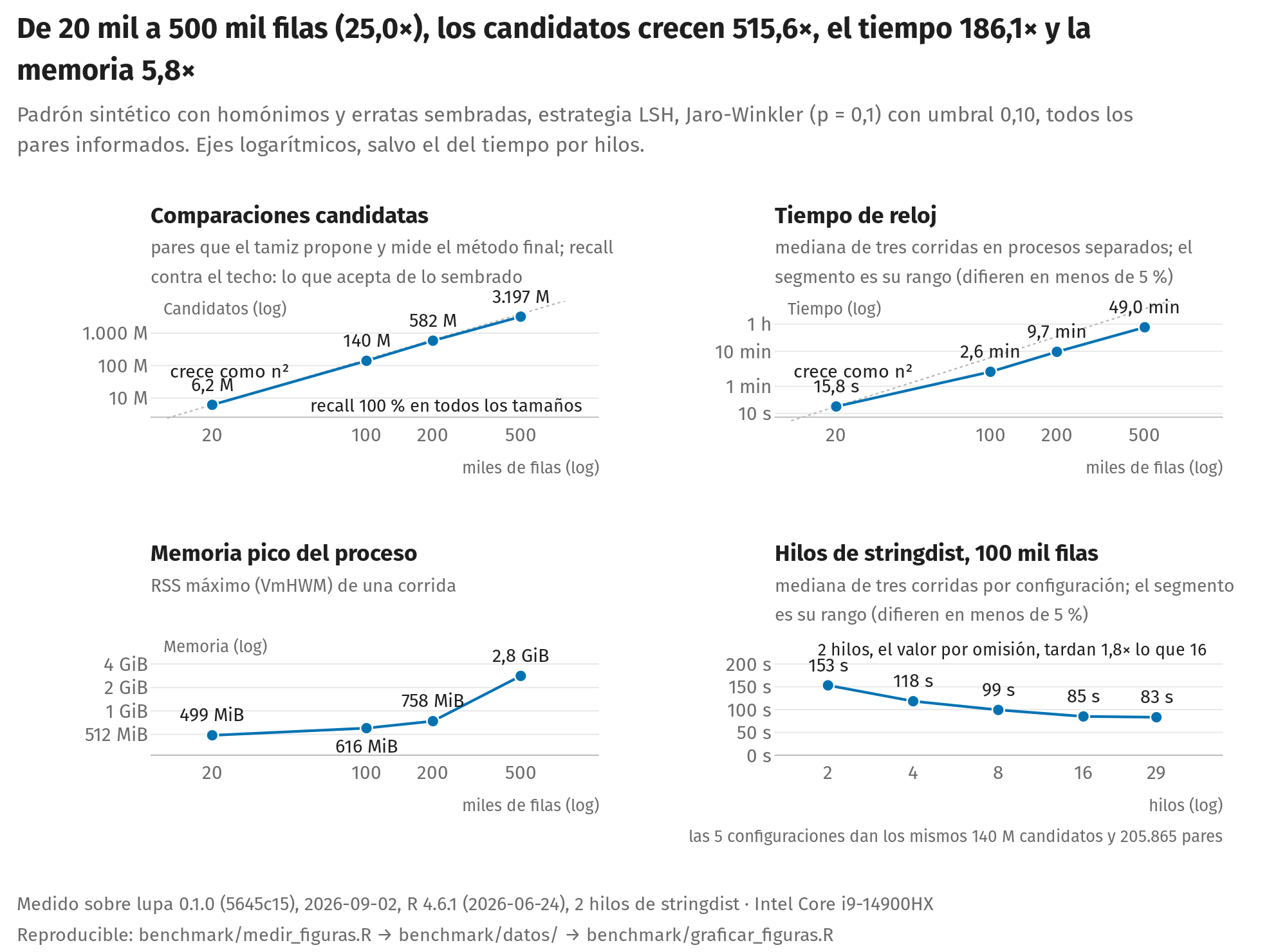
The synthetic register has homonyms and seeded typos over a small vocabulary: the shape that fills LSH buckets the most, that is, the expensive case. Candidates grow with the square of the rows —6,201,626 at 20,000, 3,197,456,226 at 500,000— and time and memory follow them: 15.8 s and 499 MiB at 20,000 rows, 49 minutes and 2.8 GiB at 500,000, with two threads. Of the seeded pairs that the final measure accepts, none is lost at any size (ceiling recall: 100 %). The fourth panel measures what the default of two threads costs at 100,000 rows: 153 s with two threads, 118 with four, 99 with eight and 85 with sixteen (1.8× between two and sixteen), and 83 with twenty-nine; candidates and pairs do not change with the threads, only the clock does. Two threads remain the default because it is the cap CRAN asks to respect, and because the gain depends on what fraction of the work falls in the comparison: on another register the curve is much flatter (the escala-y-duplicados vignette has both).
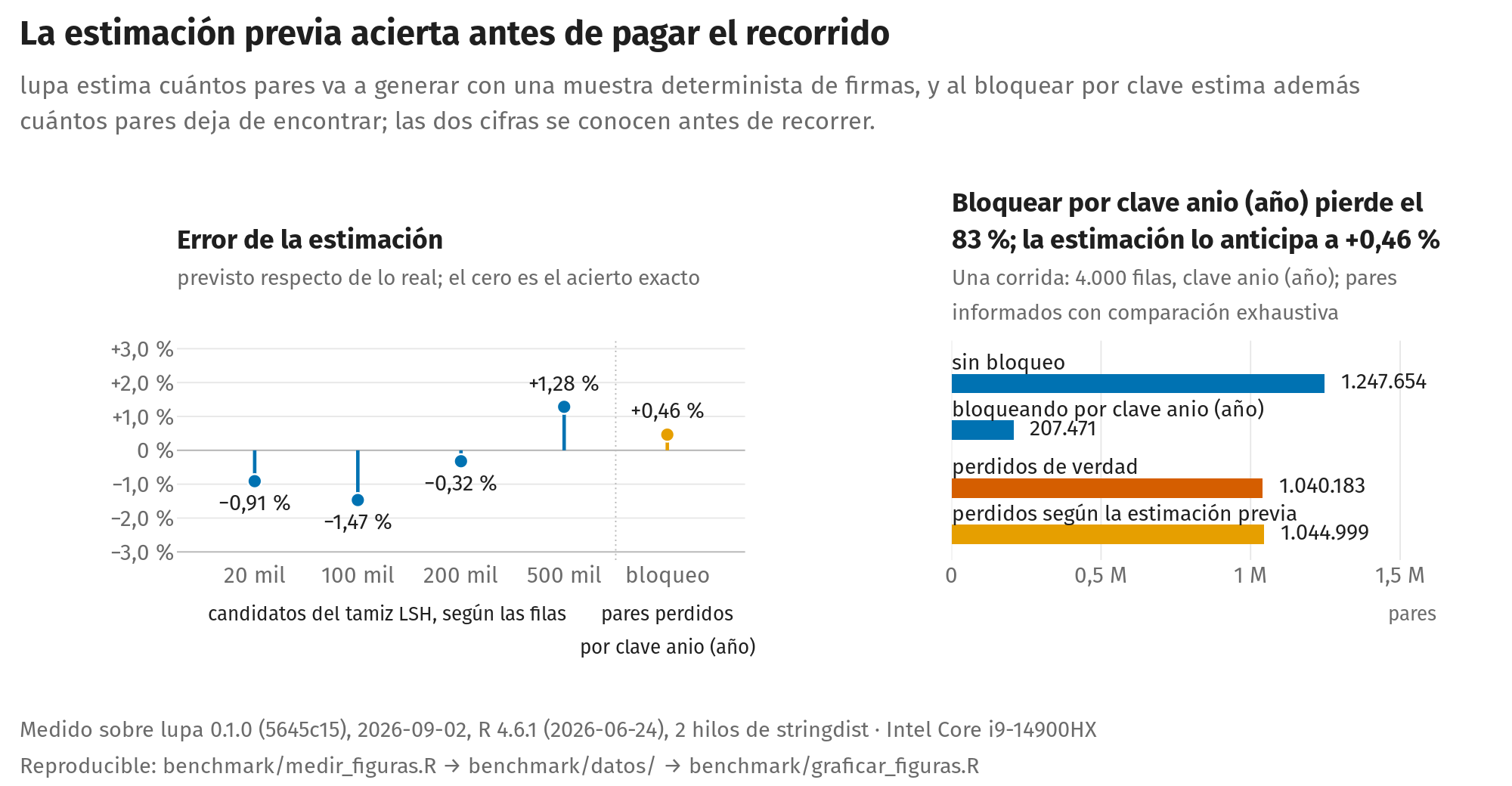
estimar_costo() says how many candidate pairs the traversal will generate before paying for it, with a deterministic sample of signatures. At the four sizes measured the error runs from −1.47 % to +1.28 %; the package promises no tolerance, the measurement is what it is. And when blocking by an arbitrary business key —anio, unrelated to the name— blocking discards 83 % of the pairs the exhaustive comparison reports (1,040,183 of 1,247,654, over 4,000 rows), and the prior estimate anticipates it with an error of +0.46 %. The key is useless for this data, and that is visible before using it.
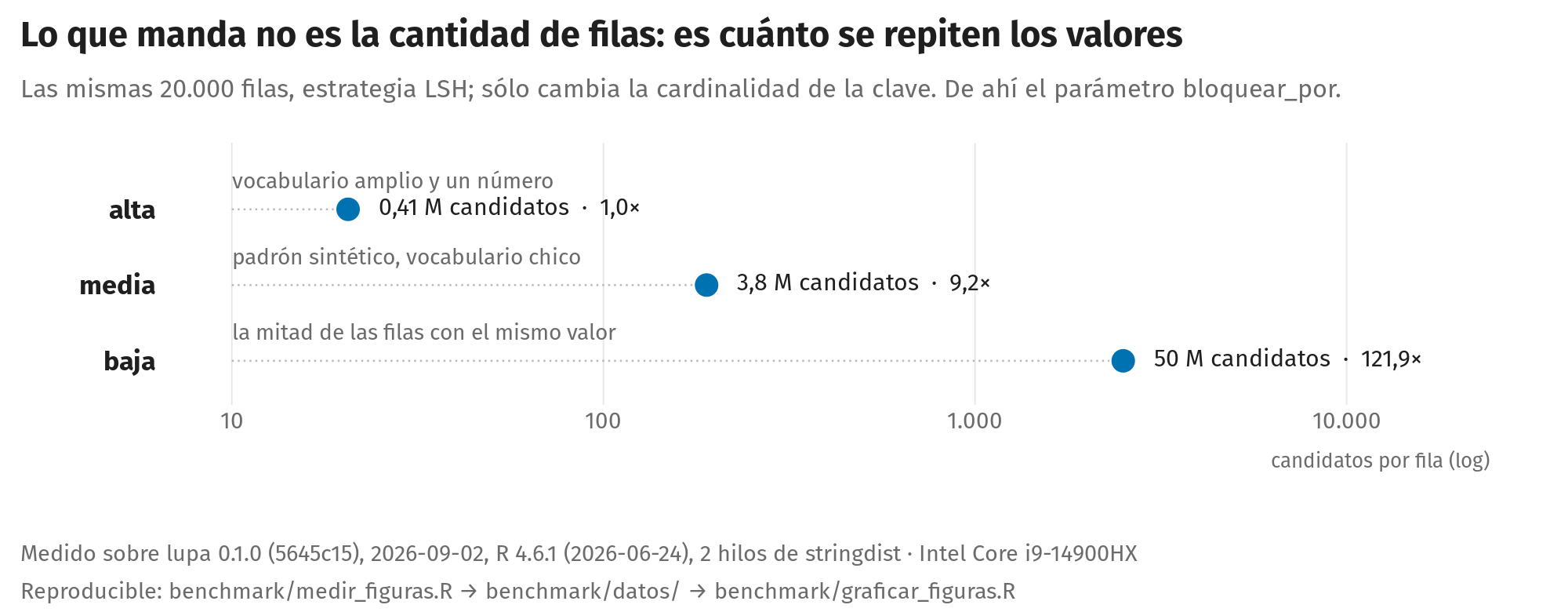
What rules is not the number of rows: it is how much the values repeat. The same 20,000 rows yield 411,051 candidates with a wide vocabulary and 50,105,210 when half of them share one value, 121.9 times more. It is the number estimar_costo() anticipates and the reason the package estimates before traversing.
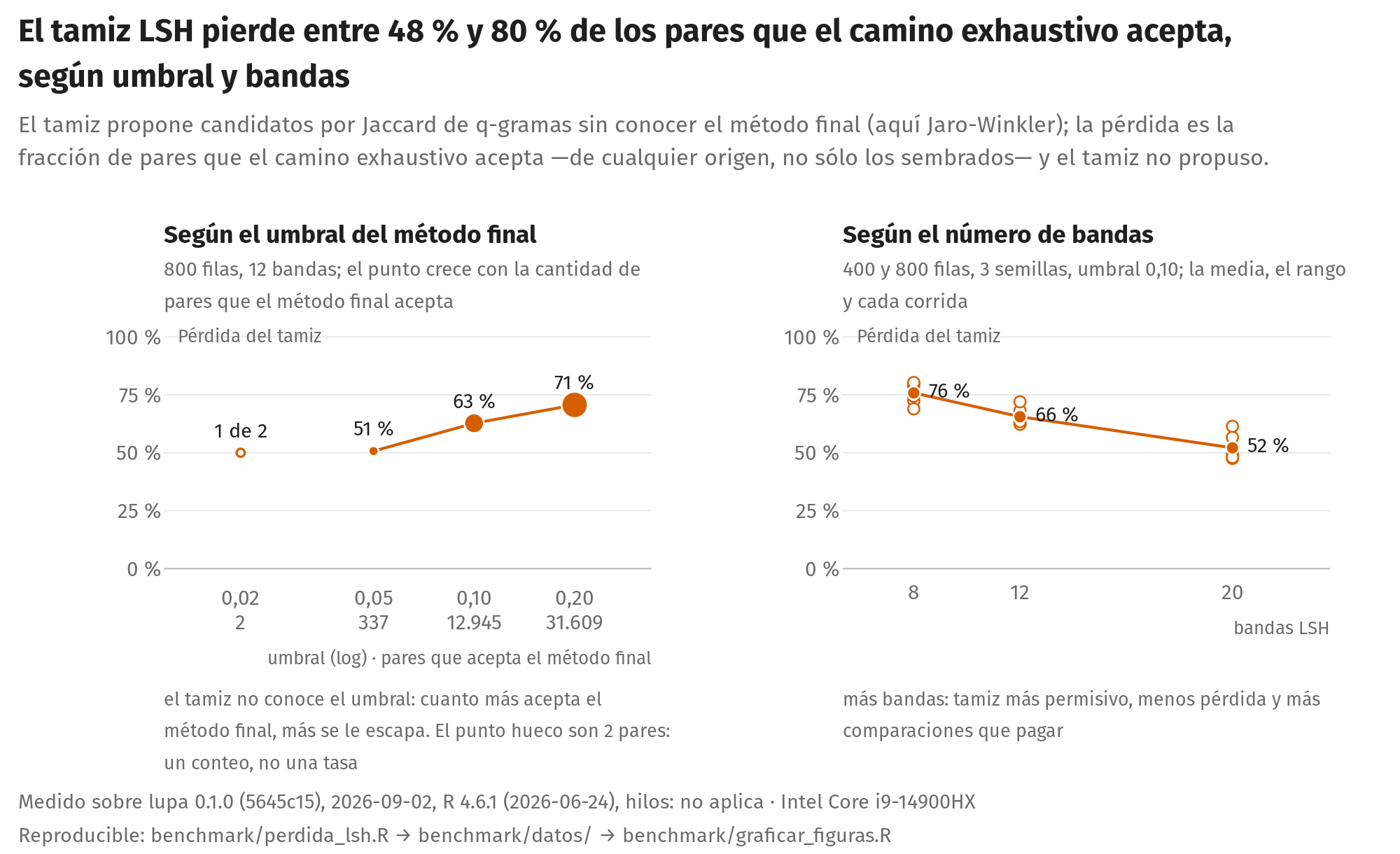
The LSH path is a sieve, not a substitute for the exhaustive one, and this figure sizes the warning that alcance already declares. Measured against the exhaustive comparison on the same input, with the other causes of loss neutralised: with 12 bands, the default, the sieve leaves out between 62 % and 72 % of the pairs Jaro-Winkler accepts at threshold 0.10 on this corpus of 400 and 800 rows; with 20 bands the loss drops to between 48 % and 61 % in exchange for more comparisons. The loss is not a property of the sieve but the distance between what it proposes and what the final method accepts: at threshold 0.02 it loses 1 of 2 pairs and at 0.20 it loses 22,336 of 31,609 (71 %). Whoever needs exhaustiveness has the exhaustive path, at its cost. The experimental design and its limits are in benchmark/perdida_lsh.md.
To rebuild the four figures from the repository root, on a quiet machine (the full run takes 3 h 34 min on this machine; with LUPA_FIGURAS_SOLO_BARATAS=1 the smoke test takes 130 s):
🔍 Limits, fit, stability, and references
There is no factory quality score: indice_calidad() returns the dashboard unless a project supplies complete named weights, and a calculated index always travels with its coverage, weights, transformations, and heterogeneous universes. The core is universal and catalogues are pluggable; AGESIC v1.6 is a reference implementation, not a country lock. It has two hard dependencies, cli and data.table, and it imports neither into its namespace: both are called with ::. That is deliberate — data.table changes what [ means for any package that imports it. Suggested packages enable bounded capabilities: sf enables geometry profiling; DBI provides the database interface and RSQLite a backend for perfilar_dbi(); stringdist enables approximate text comparison.
Work that can be parallelised uses two threads by default, the ceiling CRAN asks packages to respect. On your own machine you can raise it per call with nucleos = 8 or for the whole session with options(lupa.nucleos = 8); the result does not change, only how long it takes.
Where it fits
skimr and DataExplorer explore; pointblank, validate, and dataquieR express or evaluate rules; zoomerjoin, textreuse, and reclin2 focus on text comparison or record linkage. calidad, maintained by Klaus Lehmann and Ricardo Pizarro, is a complementary axis: it evaluates the quality of survey estimates, while lupa evaluates the tabular data that produces an estimate.
Encoding repair follows the approach and frozen data of ftfy 6.3.1 by Robyn Speer, in R. It includes eleven byte tables, CESU-8 and Java C0 80 handling, and five deliberate extensions documented in the NEWS. It reproduces 159 of the 161 distributed corpus cases and leaves 30 of the 31 negative cases untouched. The remaining one is labelled mostly negative and the corpus itself expects the repair: only its C1 control characters are fixed. It deliberately does not provide ftfy’s style-oriented fix_text steps such as HTML unescaping, quote curling, width normalization, or Unicode normalization: changing legitimate data silently is not repair.
Citation and references
citation("lupa")Conceptual references are Batini and Scannapieco (2016), the AGESIC Digital Government Data Quality Framework v1.6, and ISO/IEC 25012:2008.
Stability, contribution, and license
Version 0.1.0 is pre-CRAN: the public API may change before 1.0; breaking changes will be announced in NEWS.md and release notes, with a deprecation warning first whenever practical.
Please use the issue tracker for bugs, proposals, and documentation fixes. The stable contracts are the declared units, scope, protection, and audit trail; implementation details and benchmark times can change between releases when those contracts remain true.
lupa is released under the GPL-3. See LICENSE.note for the Apache-2.0 data derived from ftfy and the MIT data derived from naniar.